General Terms and Conditions

Disclaimer: This English version of our General Terms and Conditions is provided for information purposes only. In case of any conflict or discrepancy between the English and the German version, the German version shall prevail.

§ 1 Scope
The following terms and conditions apply between the client (hereinafter: “Client”) and BCM. GmbH as the contractor (hereinafter: “Contractor”) for all services provided by the Contractor, whether agreed in writing or verbally, unless otherwise agreed in writing. Any general terms and conditions of the Client that contradict or deviate from these Terms and Conditions shall only apply if their applicability has been expressly agreed in writing between the parties.

§ 2 Subject Matter
The Contractor performs its services in accordance with the principles of advisory services and in compliance with the recognized rules of the profession of market and social researchers.

§ 3 Scope of Services

  1. The task, the approach, the type of work results, the time required, and the fee to be paid are governed by written agreements. Changes, additions, or extensions to the task, the approach, or the type of work results require a separate written agreement. This also applies to the waiver of the written form requirement itself.
  2. The Contractor’s offer serves solely as a basis for the Client’s decision regarding the awarding of the contract. Unless otherwise agreed, the content of the offer may not be published in whole or in part by the Client or passed on to third parties.

§ 4 Exclusivity
The Contractor does not grant the Client any exclusivity unless this has been expressly agreed in writing, also with regard to duration and additional fees.

§ 5 Reports, Use
The Client receives the documentation of the work results exclusively for its own use within the scope of the contractual agreements. The content may not be published in whole or in part by the Client or passed on to third parties unless this has been expressly agreed in writing.

§ 6 Rights
Unless otherwise agreed, all rights to information and data of any kind collected or generated during the performance of the contract shall remain with the Contractor. The Client is entitled to use the information and data provided by the Contractor within the framework of the contractual agreements made.

§ 7 Naming of the Client by the Contractor
The Client agrees that the Contractor may use the Client’s company name and company logo in its external communication.

§ 8 Retention Obligation of the Contractor
The Contractor undertakes to retain survey documents and data carriers for a period of 12 months after delivery of the work results.

§ 9 Acceptance
The Contractor provides the work results performed in accordance with the contract for acceptance. If the Client does not accept the work results after they have been provided for a reason that does not constitute an immediate and justified complaint, the work result shall be deemed accepted two weeks after being provided. Any use of the work results by the Client, in whole or in part, shall be equivalent to acceptance.

§ 10 Warranty, Liability
The Contractor is liable for damages caused intentionally or through gross negligence by the Contractor or its employees, on whatever legal grounds, up to a total amount of 50% of the contract value, but no more than EUR 25,000.00 in total. Any further liability is excluded.

§ 11 Force Majeure
Events of force majeure that significantly impede or render impossible the Contractor’s performance entitle the Contractor to postpone the fulfillment of its obligation by the duration of the impediment plus an additional reasonable lead time. In the event of impossibility, the Contractor is entitled to suspend the provision of services.

§ 12 Breach of the Client’s Duties to Cooperate
If the Client fails to fulfill a contractually agreed duty to cooperate, the Contractor is entitled to terminate the contract after expiry of a reasonable grace period. The Contractor retains the claim to remuneration in accordance with § 642 para. 2 BGB. Furthermore, the Contractor’s claims for compensation of additional expenses incurred due to the delay or the Client’s failure to cooperate, as well as for damages caused, shall remain unaffected, even if the Contractor does not exercise its right to terminate.

§ 13 Fees, Additional Costs, Due Dates

  1. The fee is agreed either as a fixed price or based on actual expenditure. Project-related additional costs result from the contract. The total amount is payable without deductions. The due dates are agreed in the contract.
  2. Fees and additional costs are exclusive of value-added tax. The Client is not entitled to any right of set-off or retention.


§ 14 Miscellaneous

  1. The law of the Federal Republic of Germany shall apply. If any provisions of these General Terms and Conditions are invalid, the remaining provisions shall not be affected. The parties undertake to replace any invalid provisions with economically equivalent and valid provisions.
  2. Amendments and supplements to these General Terms and Conditions must be made in writing. This also applies to any amendment of this written-form clause.
  3. The place of jurisdiction for all disputes arising from existing contractual relationships between the parties and in connection therewith shall be the registered office of the Contractor. The Contractor is also entitled to bring claims against the Client in other places of jurisdiction.

ERP Tool Evaluation with the BCM Tool Analyzer

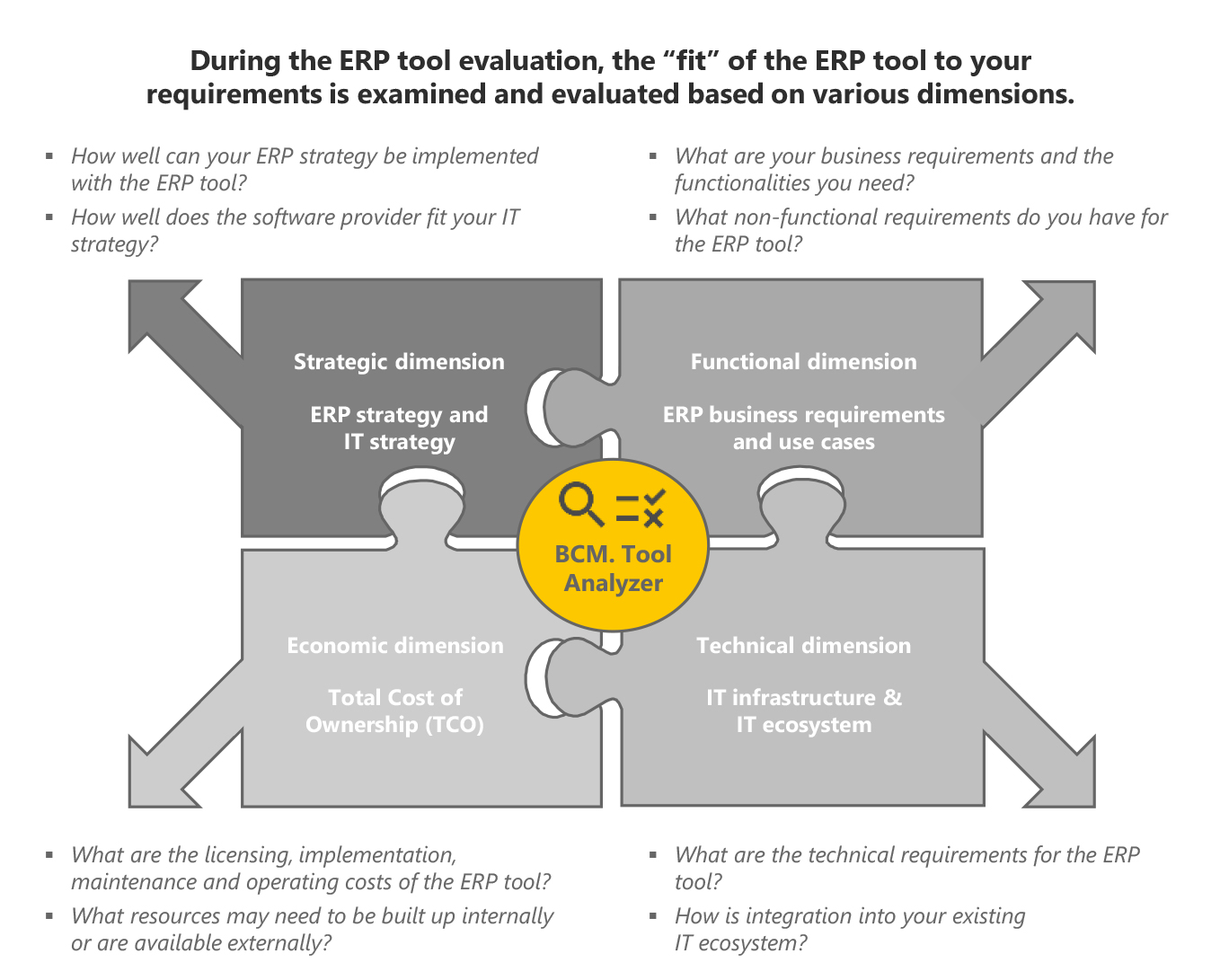
Market growth and the expansion of your market share require tool-side support that helps you map your business processes digitally and with a high degree of automation. Only with a powerful back-end system is an efficient scaling of your business activities possible.

With an ERP tool evaluation using the BCM. Tool-Analyzer, you receive structured, objective decision support to find and implement the right ERP tool for you.

In a holistic requirements analysis, we validate the requirements catalog in the BCM. Tool-Analyzer and customize it to your specific needs. On this basis, we accompany an RFI process (Request for Information) with suitable tool providers.

The vendors then conduct a tool demo or a Proof of Concept (PoC) based on previously defined use cases. Finally, the results from the RFI and the tool demo or PoC are evaluated and consolidated.

Durch die ERP-Toolevaluierung mit dem BCM. Tool-Analyzer erhalten Sie eine transparente und nachvollziehbare Entscheidungsempfehlung für ein für Sie geeignetes ERP-Tool. Damit schaffen Sie die Voraussetzungen, den “Maschinenraum” Ihres Unternehmens skalierbar und zukunftsfähig für Marktwachstum und Neugeschäft aufzustellen.

AI Strategy & AI Use Cases in Customer Management (CM)

Securing and increasing revenue and profitability is often constrained by high costs and inefficiencies in the orchestration of business processes. “Classical” customer management approaches frequently reach their limits here, as conflicts of objectives can arise, for example, between cost efficiency and the creation of a high customer experience.

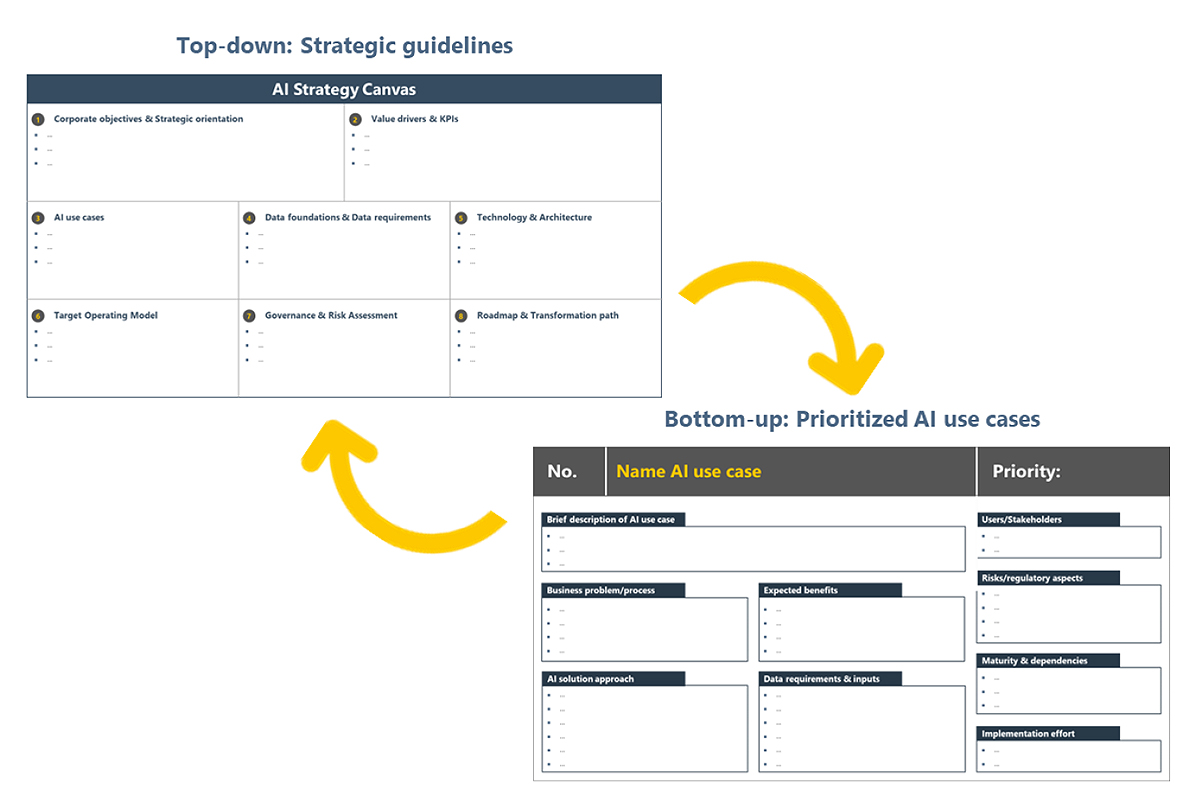
AI-based customer management can provide a remedy in this regard and resolve these conflicts of objectives. However, a targeted transformation requires a suitable and implementable AI strategy. With its help, relevant use cases can be identified and the necessary data foundations and platforms as well as the procedural, organizational, and technical requirements for a data-driven transformation can be created.

Based on the prioritized AI use cases and the previously clearly defined strategic guardrails, the AI strategy is then elaborated and detailed. An implementation roadmap and the planning of the transformation initiatives then create the prerequisites for a consistent and systematic implementation of the measures and goals defined in the AI strategy.

Mit AI-basiertem Customer Management kann die Reduktion von Kostentreibern ohne Einschränkungen der Qualität Ihrer Leistungen und ohne Einbußen bei der Customer Experience erfolgen. Dadurch schaffen Sie neue Handlungsspielräume für mehr Wachstum und wirtschaftliche Stabilität.

BCM. Maturity Assessment Data-driven Organization

Revenue growth does not automatically mean greater profitability – for example, when it comes with high sales and service costs. In addition, companies often lack a suitable, fact-based decision foundation for focusing on high-value customers.

Data and the resulting insights about customers as well as their needs and preferences, the value of business relationships, and the steering of business processes & corporate goals are therefore more than ever a critical success factor.

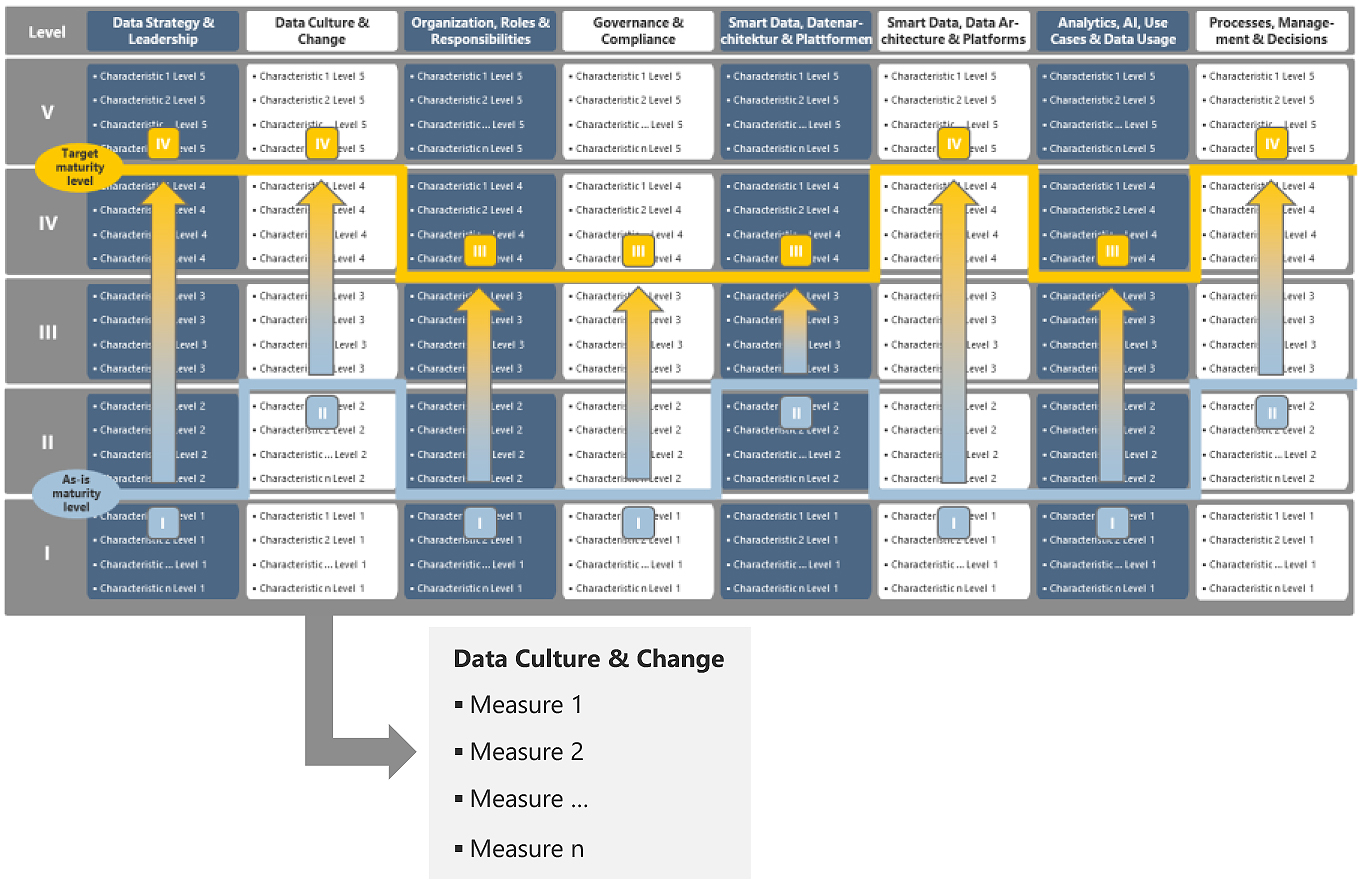
In the BCM. Maturity Assessment Data-driven Organization, we work with you in a maturity workshop to develop an as-is and target image for your company as a data-driven organization and conduct a gap analysis. On this basis, measures and recommendations for action are then derived for each maturity dimension. An implementation roadmap locates the measures to be implemented “on the timeline” and serves as the basis for a systematic implementation of the transformation path toward a data-driven organization.

As a data-driven organization, you have the necessary transparency and decision foundation to steer your business. This gives you decisive levers to uncover correlations, focus on high-value, profitable customers, and thereby secure and increase your revenue and profits.

Process Management & Process Optimization

Many companies do a lot for their customers – yet internal processes in particular often cost more time, money, and energy than necessary.

Well-functioning customer-related processes and business processes are an important foundation for the quality of customer management and the smooth orchestration of your business activities. They represent important “Moments of Truth” and form a significant basis for customer satisfaction and loyalty, while offering substantial potential for efficiency gains and cost reduction.

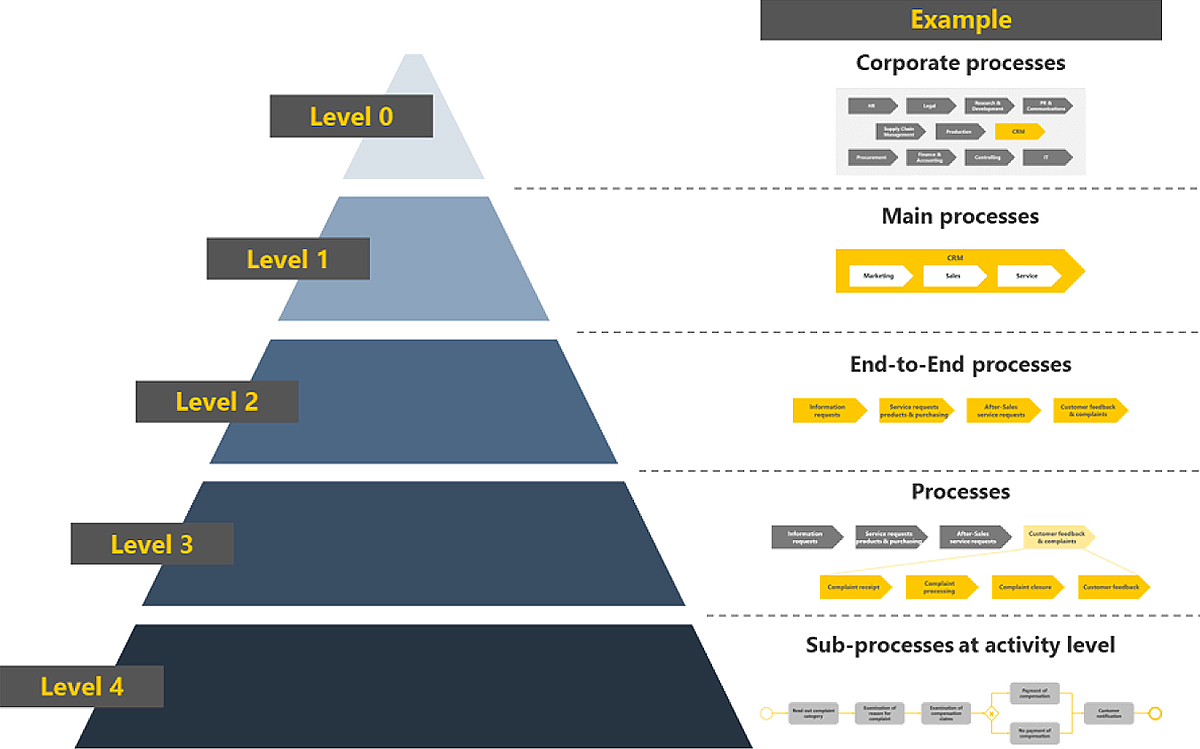
In the field of Process Management & Process Optimization, we review your existing processes and process documentation and develop a process map as an overview of your customer-related and business processes.

A process analysis reveals pain points & gaps as well as approaches for automation and digitalization, along with optimization potential for your processes, which we implement together with you.

Mit schlanken, digitalen und optimierten kundenbezogenen Prozessen und Geschäftsprozessen fokussieren Sie sich auf das Wesentliche – Ihre Kund:innen und Mitarbeiter:innen – und bieten eine erstklassige Customer Experience und optimale Unterstützung ohne “alten Ballast” in Form von Medienbrüchen, manuellen Arbeitsschritten, unklaren Verantwortlichkeiten und unnötiger Komplexität.

Business Analysis, Requirements Management & Functional Design

A lack of clarity and structure regarding goals & requirements jeopardizes the implementation and success of measures to acquire attractive new customers and retain valuable existing customers, as well as the generation of measurable business value.

Based on the business analysis of functional processes and domains, we holistically derive requirements and support you in requirements management. We bring a broad “methodological toolkit” that we apply situationally and embed in your preferred project methodology (classical, hybrid, or agile).

The detailing of your requirements for implementation is carried out via functional concepts, technical specifications, or epics and user stories, depending on the project methodology and approach used.

Together with you, we thereby create the foundation for the procedural, organizational, and technical implementation of coordinated measures for new customer acquisition, loyalty building, and long-term retention of your existing customers.

Project Steering & Implementation Management

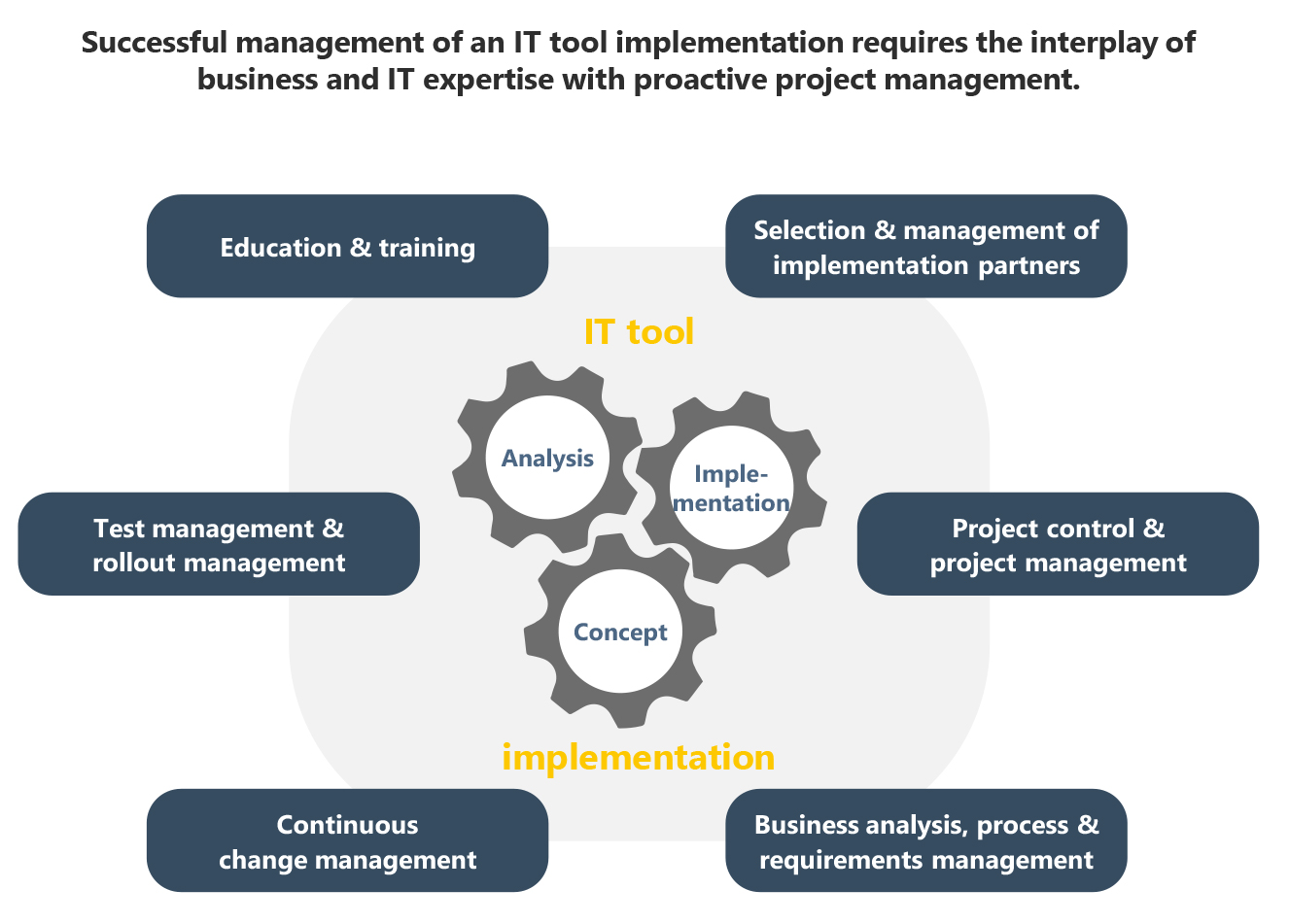
Even when your requirements for measures to acquire new customers and retain existing ones are clearly defined and a “clean” conceptual foundation is in place, implementation projects can still fail without clear steering of project teams from the business side, IT, and external service providers.

In the field of Project Steering & Implementation Management, we support you, for example, in the selection and management of a suitable IT tool implementation partner.

In addition, together with you, we bring your requirements to implementation readiness and steer their implementation in the IT tool to be implemented in close coordination with the project team and the implementation partner.

Through continuous change management, we ensure early user involvement and thus promote the acceptance that is of decisive importance for the success of the project.

Proactive project steering and a holistic management of your implementation projects ensure that your projects for customer acquisition and retention are successfully implemented and “really take off.”

CRM Tool Evaluation with the BCM Tool Analyzer

Acquiring promising new customers and retaining valuable existing customers requires a suitable CRM ecosystem for operational implementation. The challenge is to find, among the multitude of CRM tools, the right solution that optimally supports you in customer acquisition and retention.

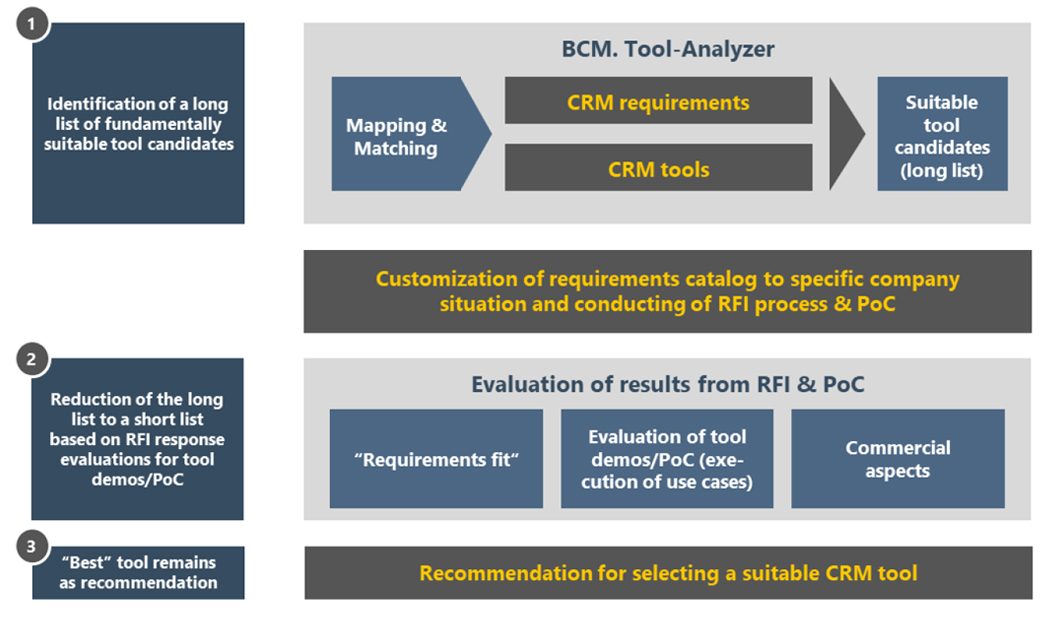
With a CRM tool evaluation, you receive structured, objective decision support to find and implement the right CRM tool for you.

With the BCM. Tool-Analyzer, we first identify fundamentally suitable CRM tool candidates based on your requirements.

On this basis, we accompany an RFI process (Request for Information), during which the providers also conduct a tool demo or a Proof of Concept (PoC) based on previously defined use cases. Through a final evaluation and result consolidation, you receive a transparent, neutral, and comprehensible decision recommendation for a CRM tool or CRM ecosystem that suits you.

A suitable CRM tool or CRM ecosystem is an important foundation for implementing your customer acquisition and retention measures in a goal-oriented, efficient, and automated way – allowing you to achieve your CRM objectives.

BCM. Maturity Assessment Customer Management (CM)

Many companies invest heavily in marketing, sales, and systems – yet the results often fall short of expectations. One difficulty is that while many individual initiatives for customer acquisition and retention exist, a coherent overall picture and a coordinated orchestration are missing.

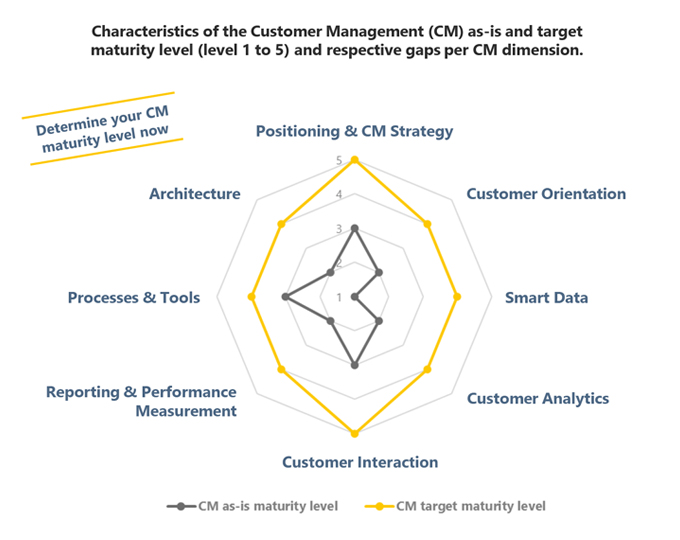
In the Maturity Assessment Customer Management (CM), we conduct a joint maturity workshop with you to perform a “positioning” of your status quo and define your desired target maturity level. A gap analysis between the current situation and the desired ambition level provides insights into the necessary measures to be implemented in the respective CM dimensions. The derived CM measures for achieving the target maturity level form the basis for a prioritized implementation roadmap.

The structured approach of the BCM. Maturity Assessment Customer Management (CM) creates a holistic, shared understanding among the various CM areas and relevant stakeholders, and develops a strategic blueprint. This broadens the perspective from individual measures to a comprehensive overall picture and outlines the necessary steps to ensure that the individual initiatives work together optimally. Through the concerted orchestration of these measures, you lay the foundation for attracting attractive customers and building long-term relationships with your valuable existing customers.