













As central, integrated software solutions, Enterprise Resource Planning (ERP) tools map the business processes of companies. They form the IT backend and core system to enable, support, and steer the operational handling of corporate activities.
ERP tools integrate various functional and data areas of companies, thereby enabling a unified view of central corporate processes. ERP tools are also in close exchange with IT tools from other functional areas, such as CRM tools. As integrated IT tools, they support the digital transformation of companies through standardization and automation of business processes, enabling efficient process orchestration and the making of corporate decisions based on up-to-date information.
In the area of Enterprise Resource Planning, we support you with an ERP tool evaluation to help select the ERP tools suitable for your specific business situation and requirements. After selecting the appropriate ERP tool for you, we assist with the implementation through project steering and implementation management.
The operationalization of your corporate and ERP strategy requires tool-based support that helps you handle your business processes digitally, efficiently, and with a high degree of automation.
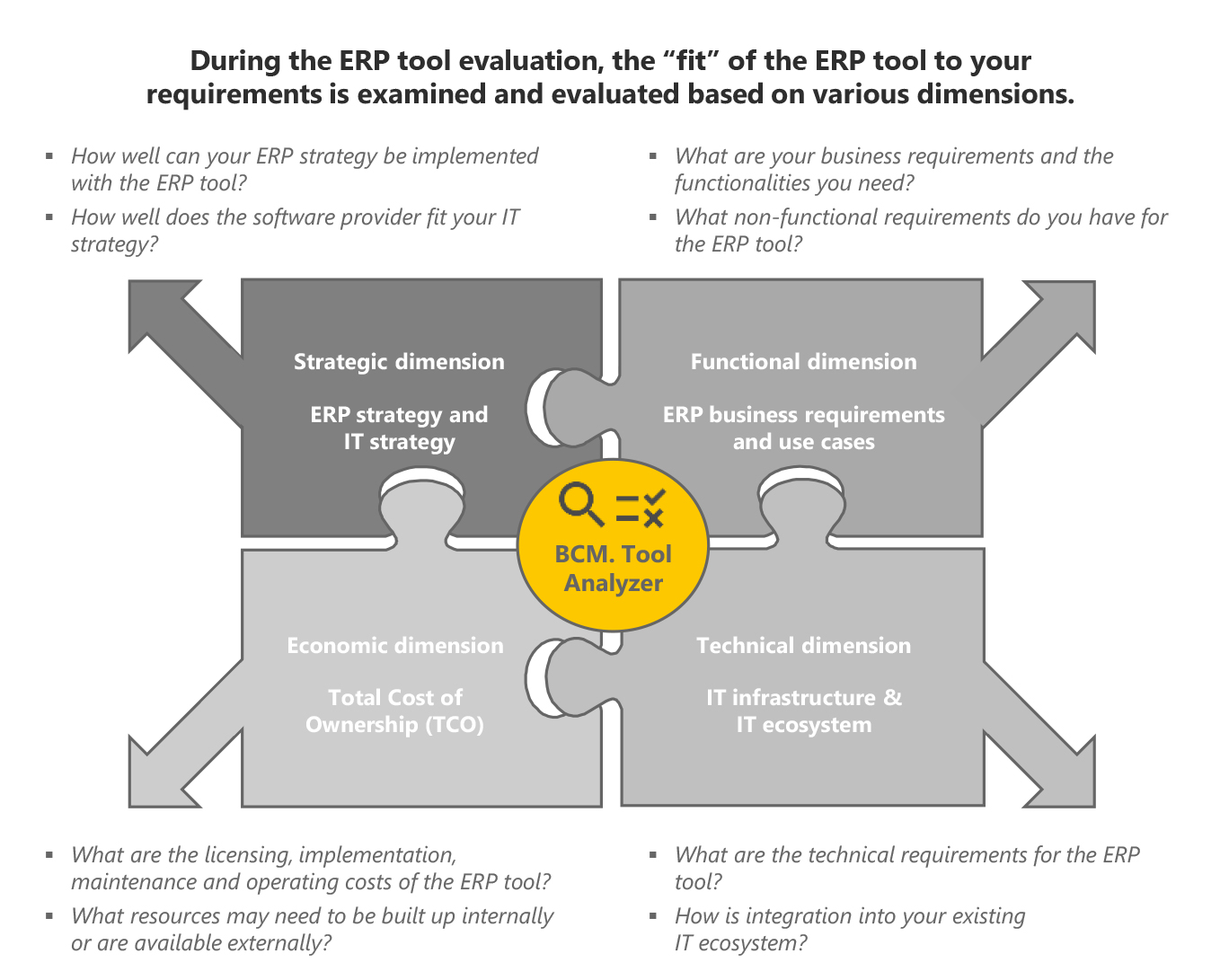
With an ERP tool evaluation, you receive structured and objective decision support to find and introduce the ERP tool that is right for you.
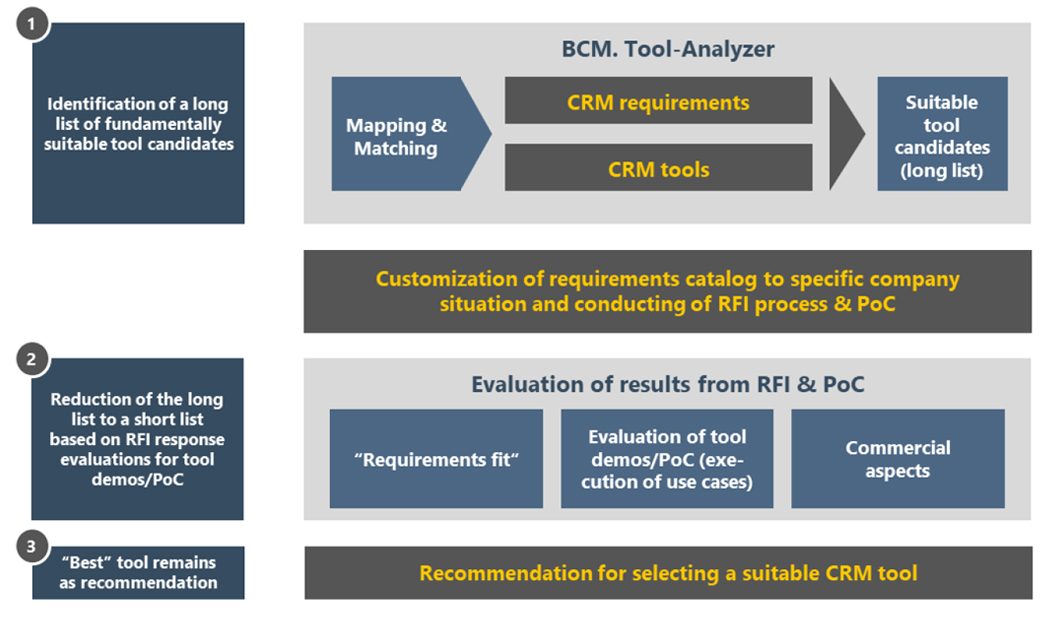
Based on your requirements and framework conditions, we first identify fundamentally suitable ERP tool candidates via the BCM. Tool-Analyzer (long list).
In a subsequent holistic requirements analysis, we validate the requirements catalog in the BCM. Tool-Analyzer and customize it to your specific needs. On this basis, we accompany an RFI process (Request for Information) with the vendors on the long list.
After evaluating the results from the RFI process, the vendors are narrowed down to a short list. These vendors then conduct a tool demo or a Proof of Concept (PoC) based on previously defined use cases.
Finally, the final evaluation and result consolidation from the RFI and tool demo or PoC takes place. This provides you with a transparent and comprehensible decision recommendation for a suitable ERP tool. This is based on the “requirements fit,” the evaluation of tool demos/PoC (use case execution), and commercial aspects (e.g., license and implementation costs).
Make your ERP decision on a solid foundation.
In a first conversation, we’ll show you how to structure the selection, evaluation, and implementation of your ERP system in a structured and low-risk way.
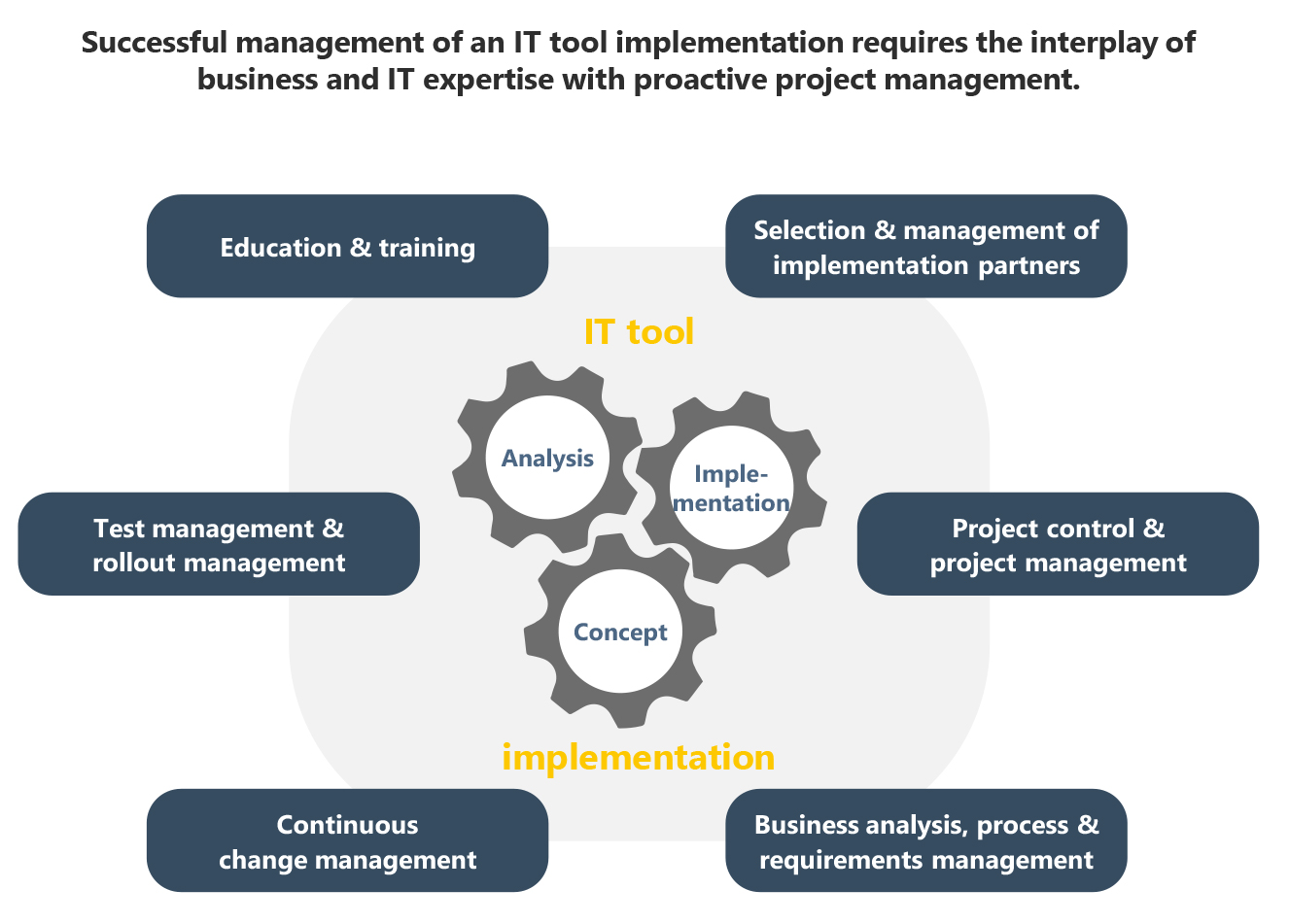
Adequate IT support is the prerequisite for an effective and efficient orchestration of your business processes and optimal support for your customers and employees. This requires that your functional and technical requirements are suitably implemented, your processes are optimally designed, and the implementation project is proactively managed.
In the field of Project Steering & Implementation Management, we support you, for example, in the selection and management of a suitable IT tool implementation partner.
In addition, together with you, we bring your requirements to implementation readiness and steer their implementation in the IT tool to be implemented in close coordination with the project team and the implementation partner.
Through continuous change management, we ensure early user involvement and thus promote the acceptance that is of decisive importance for the success of the project.
Make your ERP decision on a solid foundation.
In a first conversation, we’ll show you how to structure the selection, evaluation, and implementation of your ERP system in a structured and low-risk way.
Whether it’s an initial idea or a specific project: we listen, think along with you, and develop tailor-made solutions together. Talk to us about your goals – we look forward to getting to know and supporting you.
at +49 (0) 172 4142 255
We look forward to meeting you!
Yours, Thomas Hamele
We look forward to meeting you!
Yours, Thomas Hamele
Market growth and the expansion of your market share require tool-side support that helps you map your business processes digitally and with a high degree of automation. Only with a powerful back-end system is an efficient scaling of your business activities possible.
With an ERP tool evaluation using the BCM. Tool-Analyzer, you receive structured, objective decision support to find and implement the right ERP tool for you.
In a holistic requirements analysis, we validate the requirements catalog in the BCM. Tool-Analyzer and customize it to your specific needs. On this basis, we accompany an RFI process (Request for Information) with suitable tool providers.
The vendors then conduct a tool demo or a Proof of Concept (PoC) based on previously defined use cases. Finally, the results from the RFI and the tool demo or PoC are evaluated and consolidated.
Through the ERP tool evaluation with the BCM. Tool-Analyzer, you receive a transparent and comprehensible decision recommendation for an ERP tool that suits you. This creates the prerequisites for setting up the “engine room” of your company in a scalable and future-ready manner for market growth and new business.
Securing and increasing revenue and profitability is often constrained by high costs and inefficiencies in the orchestration of business processes. “Classical” customer management approaches frequently reach their limits here, as conflicts of objectives can arise, for example, between cost efficiency and the creation of a high customer experience.
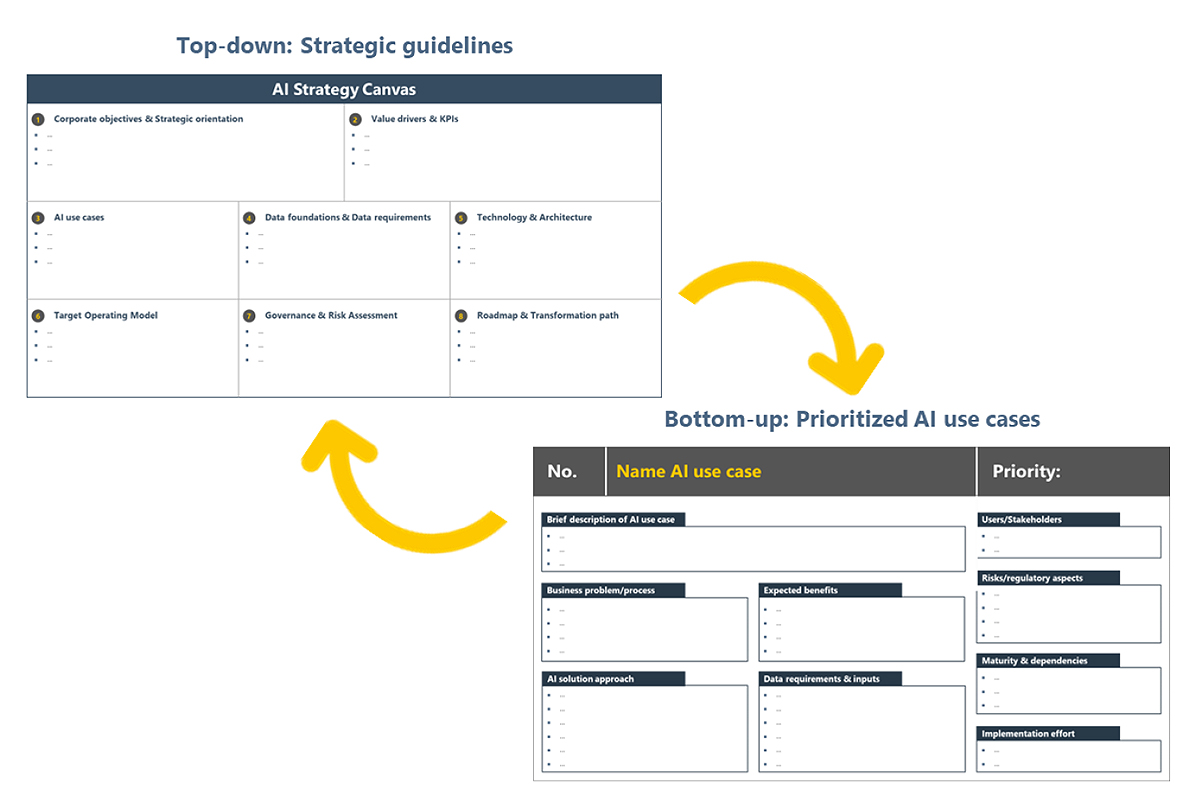
AI-based customer management can provide a remedy in this regard and resolve these conflicts of objectives. With its help, relevant use cases can be identified and the necessary data foundations and platforms as well as the procedural, organizational, and technical requirements for a data-driven transformation can be created.
Based on the prioritized AI use cases and the previously clearly defined strategic guardrails, the AI strategy is then elaborated and detailed. An implementation roadmap and the planning of the transformation initiatives then create the prerequisites for a consistent and systematic implementation of the defined measures and goals.
With AI-based customer management, cost drivers can be reduced without compromising the quality of your services or the customer experience. This creates new room for action for greater growth and economic stability.
Revenue growth does not automatically mean greater profitability – for example, when it comes with high sales and service costs. In addition, companies often lack a suitable, fact-based decision foundation for focusing on high-value customers.
Data and the resulting insights about customers as well as their needs and preferences, the value of business relationships, and the steering of business processes & corporate goals are therefore more than ever a critical success factor.
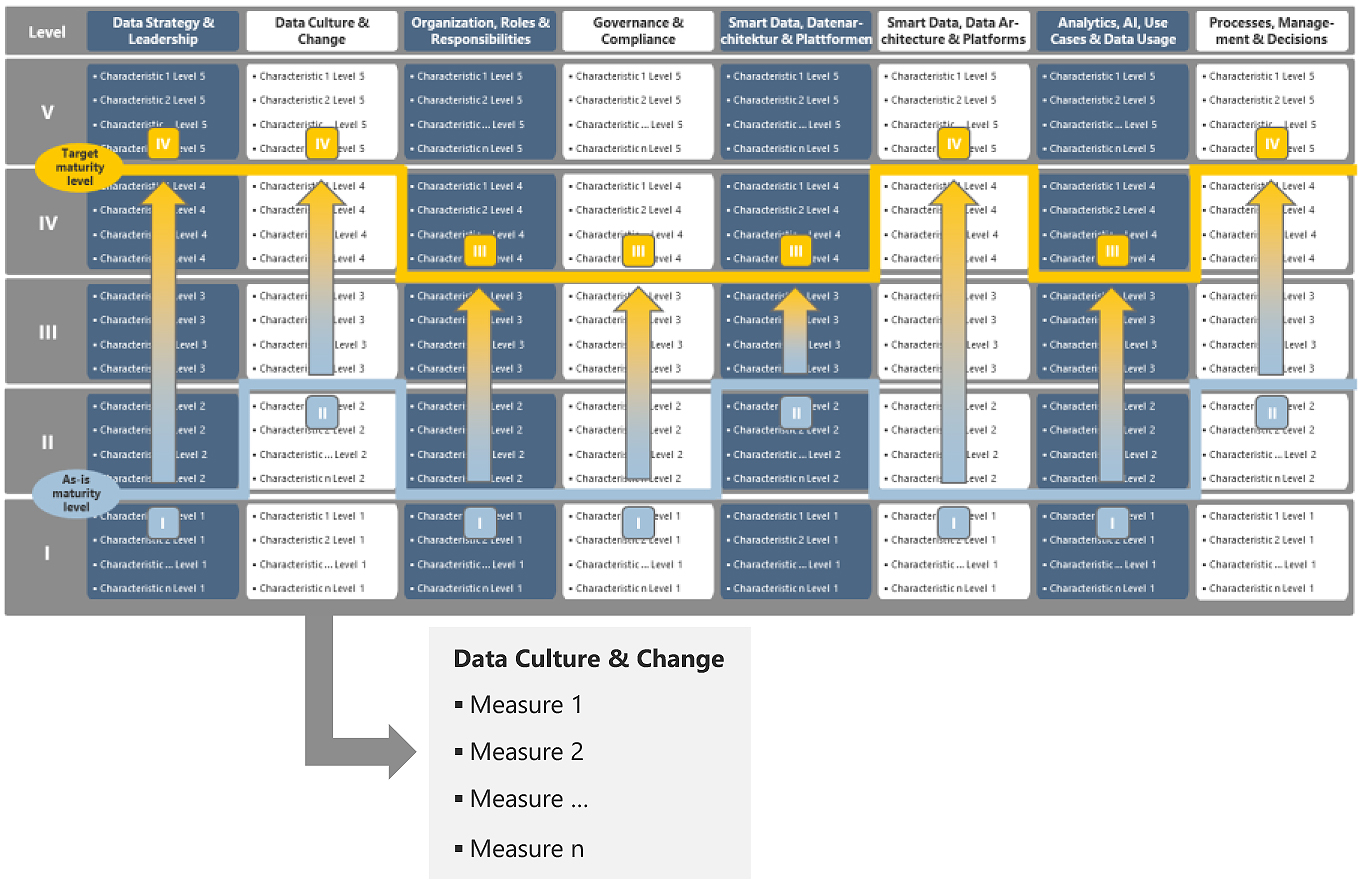
In the BCM. Maturity Assessment Data-driven Organization, we work with you in a maturity workshop to develop an as-is and target image for your company as a data-driven organization and conduct a gap analysis. On this basis, measures and recommendations for action are then derived for each maturity dimension. An implementation roadmap locates the measures to be implemented “on the timeline” and serves as the basis for a systematic implementation of the transformation path toward a data-driven organization.
As a data-driven organization, you have the necessary transparency and decision foundation to steer your business. This gives you decisive levers to uncover correlations, focus on high-value, profitable customers, and thereby secure and increase your revenue and profits.
Many companies do a lot for their customers – yet internal processes in particular often cost more time, money, and energy than necessary.
Well-functioning customer-related processes and business processes are an important foundation for the quality of customer management and the smooth orchestration of your business activities. They represent important “Moments of Truth” and form a significant basis for customer satisfaction and loyalty, while offering substantial potential for efficiency gains and cost reduction.
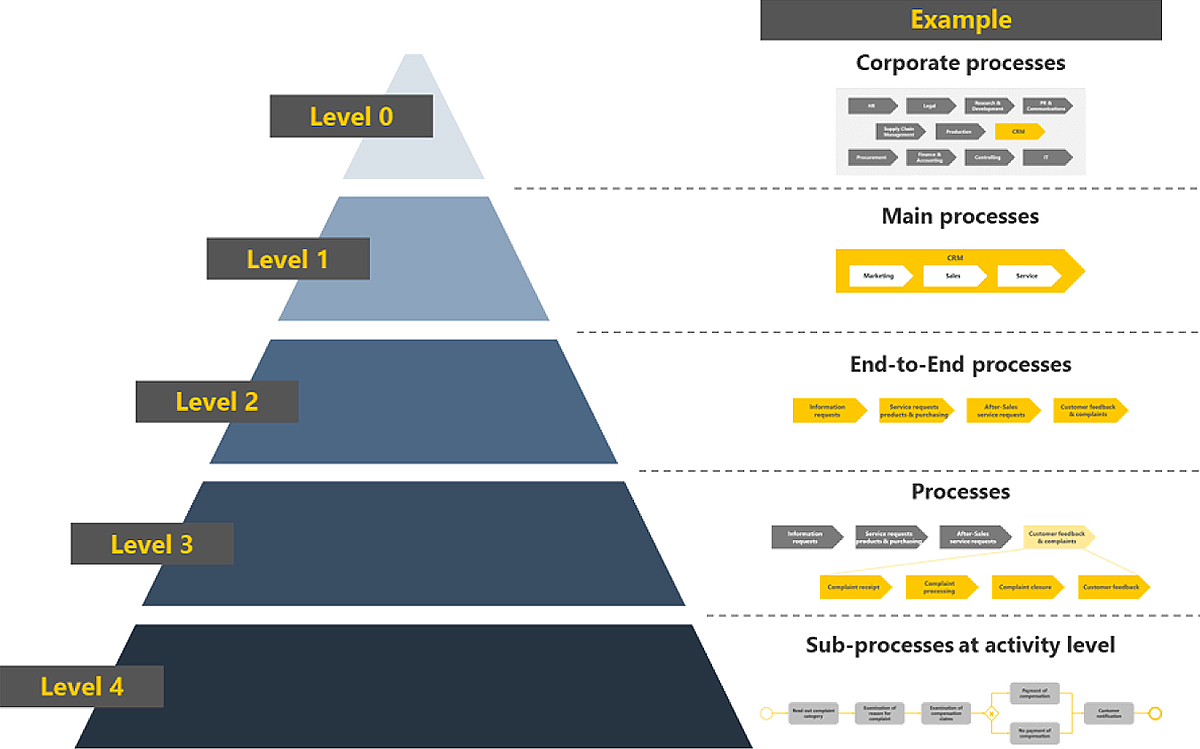
In the field of Process Management & Process Optimization, we review your existing processes and process documentation and develop a process map as an overview of your customer-related and business processes.
A process analysis reveals pain points & gaps as well as approaches for automation and digitalization, along with optimization potential for your processes, which we implement together with you.
With lean, digital, and optimized customer-related and business processes, you focus on what truly matters – your customers and employees – and deliver a first-class customer experience and optimal support, without the “old baggage” of media breaks, manual work steps, unclear responsibilities, and unnecessary complexity.
A lack of clarity and structure regarding goals & requirements jeopardizes the implementation and success of measures to acquire attractive new customers and retain valuable existing customers, as well as the generation of measurable business value.
Based on the business analysis of functional processes and domains, we holistically derive requirements and support you in requirements management. We bring a broad “methodological toolkit” that we apply situationally and embed in your preferred project methodology (classical, hybrid, or agile).
The detailing of your requirements for implementation is carried out via functional concepts, technical specifications, or epics and user stories, depending on the project methodology and approach used.
Together with you, we thereby create the foundation for the procedural, organizational, and technical implementation of coordinated measures for new customer acquisition, loyalty building, and long-term retention of your existing customers.
Even when your requirements for measures to acquire new customers and retain existing ones are clearly defined and a “clean” conceptual foundation is in place, implementation projects can still fail without clear steering of project teams from the business side, IT, and external service providers.
In the field of Project Steering & Implementation Management, we support you, for example, in the selection and management of a suitable IT tool implementation partner.
In addition, together with you, we bring your requirements to implementation readiness and steer their implementation in the IT tool to be implemented in close coordination with the project team and the implementation partner.
Through continuous change management, we ensure early user involvement and thus promote the acceptance that is of decisive importance for the success of the project.
Proactive project steering and a holistic management of your implementation projects ensure that your projects for customer acquisition and retention are successfully implemented and “really take off.”
Acquiring promising new customers and retaining valuable existing customers requires a suitable CRM ecosystem for operational implementation. The challenge is to find, among the multitude of CRM tools, the right solution that optimally supports you in customer acquisition and retention.
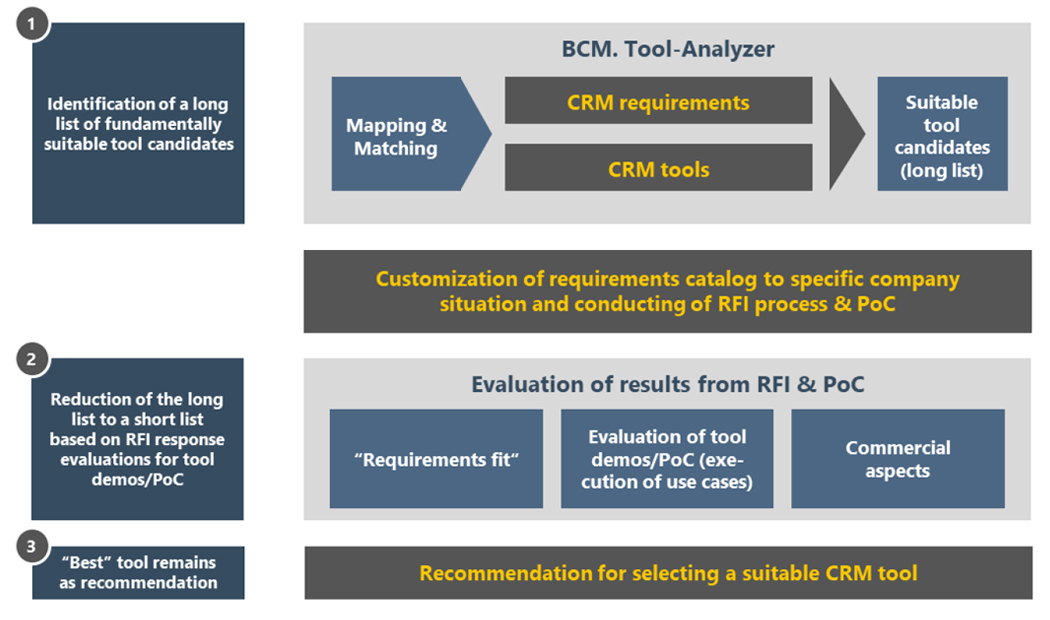
With a CRM tool evaluation, you receive structured, objective decision support to find and implement the right CRM tool for you.
With the BCM. Tool-Analyzer, we first identify fundamentally suitable CRM tool candidates based on your requirements.
On this basis, we accompany an RFI process (Request for Information), during which the providers also conduct a tool demo or a Proof of Concept (PoC) based on previously defined use cases. Through a final evaluation and result consolidation, you receive a transparent, neutral, and comprehensible decision recommendation for a CRM tool or CRM ecosystem that suits you.
A suitable CRM tool or CRM ecosystem is an important foundation for implementing your customer acquisition and retention measures in a goal-oriented, efficient, and automated way – allowing you to achieve your CRM objectives.
Many companies invest heavily in marketing, sales, and systems – yet the results often fall short of expectations. One difficulty is that while many individual initiatives for customer acquisition and retention exist, a coherent overall picture and a coordinated orchestration are missing.
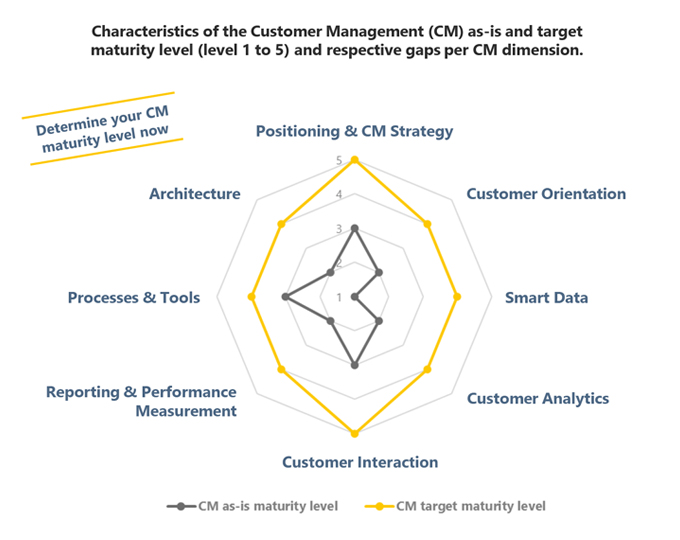
In the Maturity Assessment Customer Management (CM), we conduct a joint maturity workshop with you to perform a “positioning” of your status quo and define your desired target maturity level. A gap analysis between the current situation and the desired ambition level provides insights into the necessary measures to be implemented in the respective CM dimensions. The derived CM measures for achieving the target maturity level form the basis for a prioritized implementation roadmap.
The structured approach of the BCM. Maturity Assessment Customer Management (CM) creates a holistic, shared understanding among the various CM areas and relevant stakeholders, and develops a strategic blueprint. This broadens the perspective from individual measures to a comprehensive overall picture and outlines the necessary steps to ensure that the individual initiatives work together optimally. Through the concerted orchestration of these measures, you lay the foundation for attracting attractive customers and building long-term relationships with your valuable existing customers.